


03 Nov Plotter vs Printer: What’s the Difference and Which Does Your Office Need?
- Plotter vs printer: today's "plotters" are wide format inkjet or toner printers that print on rolls 24 to 44 inches wide or more. Office printers top out around tabloid size.
- If you print full-size drawings, plans or maps more than occasionally, an office printer cannot do the job. You need a plotter or an outsourced print service.
- Compare cost per print, not just the purchase price: ink or toner, media, service and your time all count.
- Multifunction plotters add a wide format scanner, so you can copy and digitize large drawings in-house.
- Buy, lease or outsource based on your volume, deadlines and how much control you need.
"Do we need a plotter, or can the office printer handle it?" It is a common question in growing architecture, engineering and construction offices. The answer depends on the size of what you print, how often you print it and how fast you need it.
This guide explains the real difference between a plotter and a printer today, compares them on size, speed, quality and cost, and helps you decide whether to buy, lease or outsource.
What is a plotter?
Pen plotters vs modern inkjet plotters
The original plotters drew vector lines with pens moving over the paper. They were precise but slow and limited to linework. Today, almost every device sold as a "plotter" is a wide format inkjet or toner printer that prints raster images, very quickly, on wide rolls of media. The name stuck because architects and engineers still use them to "plot" CAD drawings. HP explains the evolution in its overview of what a plotter printer is.
What is a wide format printer?
Technical vs graphics printers
Wide format printers fall into two broad groups. Technical printers are tuned for CAD linework, monochrome and color drawings, and speed on bond paper. Graphics printers are tuned for photographic color on coated and photo media, for posters, signage and renderings. Many AEC offices need technical output most of the time and occasional presentation graphics. Inkjet and toner-based (LED or laser) systems are both available, each with different media and running-cost profiles.
Plotter vs printer side by side
Size
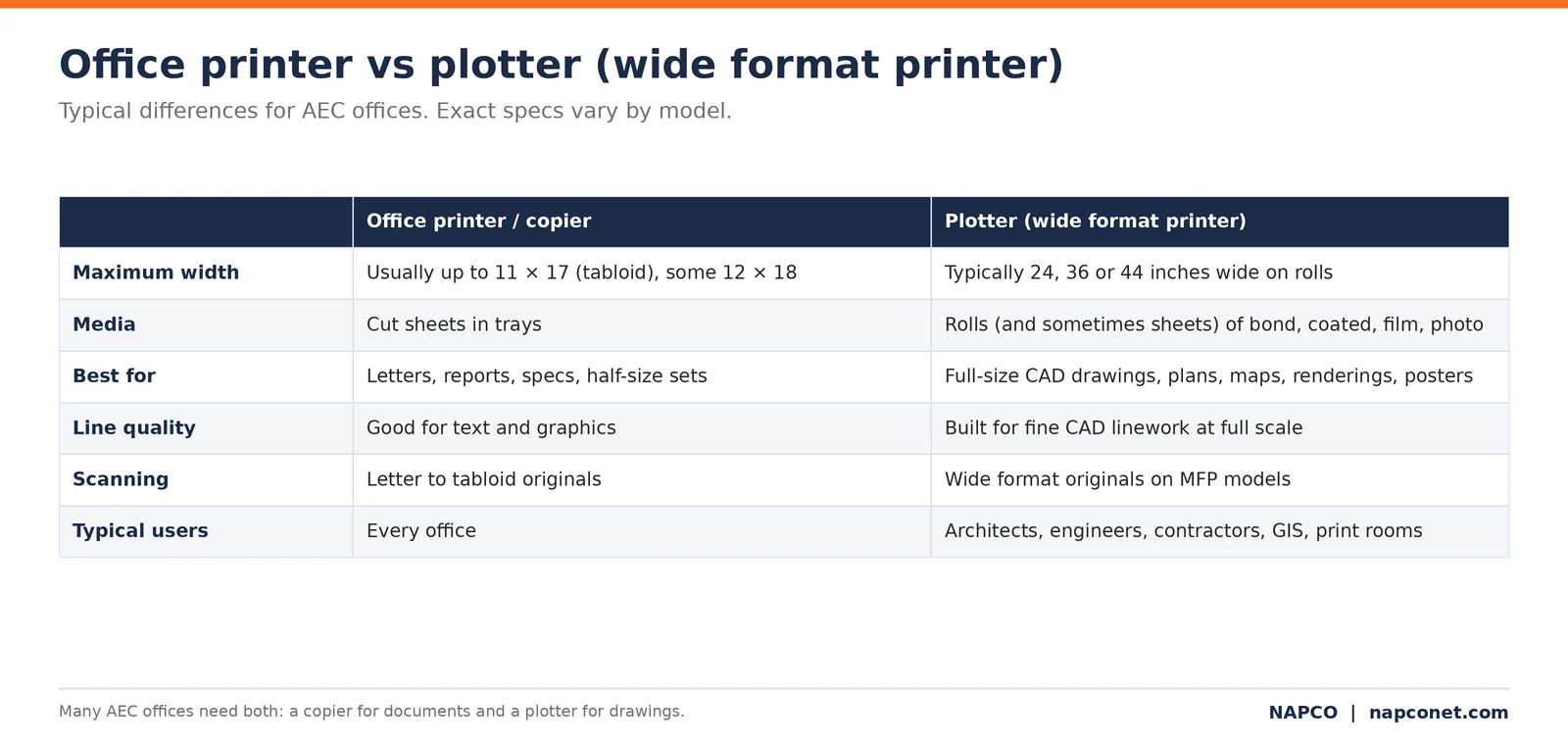
This is the defining difference. Most office printers and copiers print up to 11 × 17, with some handling 12 × 18. Plotters print on rolls 24, 36 or 44 inches wide, covering ARCH D (24 × 36), ARCH E (36 × 48) and longer banners or maps. Choose the plotter width based on your largest common sheet.
Speed
Office printers are fast at many small pages. Plotters are fast at large ones. Entry-level plotters may take tens of seconds per D-size sheet, while production systems such as HP PageWide XL print large sets much faster. Read our comparison of HP DesignJet vs HP PageWide XL to see how speed changes with volume.
Print quality
Plotters are built to keep fine lines sharp and accurate to scale across a full sheet. Office printers produce good text and graphics, but they cannot print a full-size drawing at all, and tiling a drawing across several sheets is not practical for real work.
Cost per print
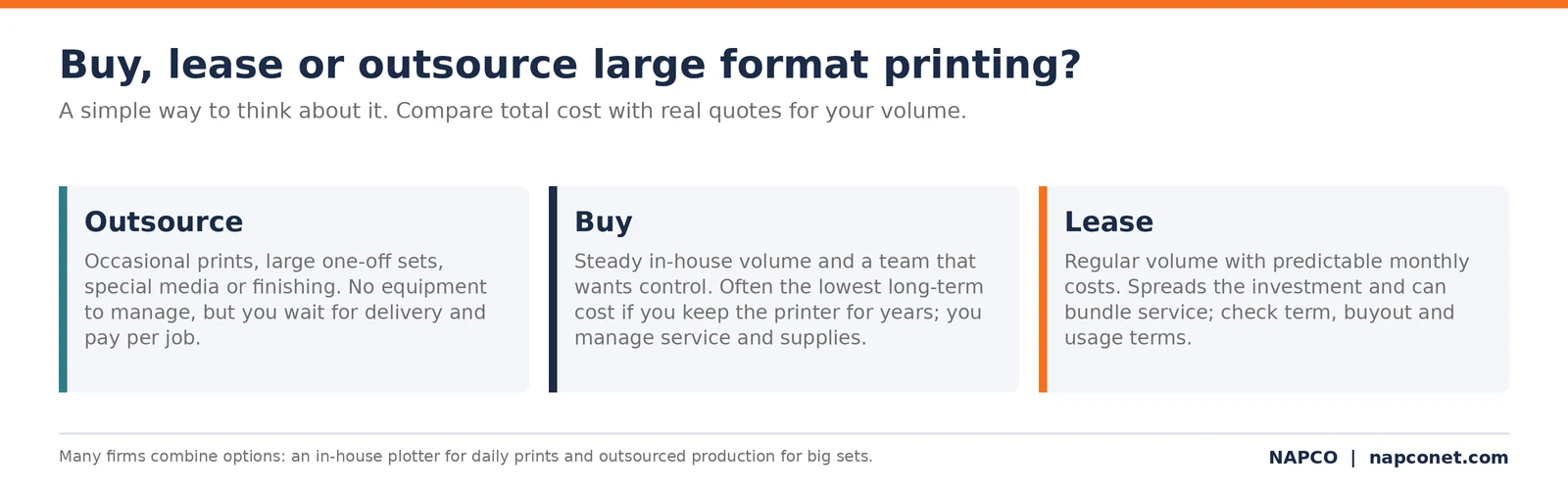
Cost per print includes ink or toner, media, maintenance and service, plus the share of the printer's purchase or lease cost. For large drawings, an in-house plotter usually costs less per sheet than sending every job out, once volume is steady. For a handful of sets a year, outsourcing is often cheaper. Our budgeting tips for large format printers explain how to estimate it.
Takeaway: Size decides whether you need a plotter. Volume decides whether it pays to own one.
When an office printer is enough
Letter and tabloid needs
If your output is mostly reports, specifications, proposals and half-size 11 × 17 drawing sets, a good office copier or MFP is enough. Many small firms print half-size sets in-house and send the occasional full-size set to a print provider. NAPCO supplies office copiers and MFPs for this everyday work.
When you need a plotter
CAD drawings and blueprints
If you regularly print full-size construction drawings for review, permits, bid sets or field use, a plotter saves time and keeps sensitive drawings in-house. Same-day revisions are easy when the printer is down the hall.
Maps and presentations
Site plans, GIS maps, renderings and presentation boards need wide format output, often in color on coated or photo media. A plotter that handles both technical and graphics output covers most needs.
Single-function vs multifunction plotters
Built-in scanners
Multifunction plotters add a wide format scanner. You can scan marked-up drawings, old blueprints and as-built sets to PDF, then share or archive them. Models such as the HP DesignJet T2600 MFP and the HP DesignJet XL 3600 MFP combine printing, scanning and copying in one device.
Copying large drawings
With an MFP, copying a full-size drawing takes one step instead of a scan-then-print workflow. For large backlogs of paper drawings, a dedicated document scanning service may be faster than scanning in-house.
Buy, lease or outsource?
Volume thresholds
There is no universal break-even point, because it depends on media, coverage, color and labor. A practical approach: total what you spent on outsourced large format printing last year, estimate the number of sheets, and compare that with quotes for a plotter (purchase or lease) plus supplies and service at the same volume. If you print full-size sheets every week, owning or leasing often pays off. If you print a few sets a quarter, outsourcing usually wins.
Service and supplies
Plan for printheads, ink or toner, media and maintenance. Downtime is expensive near a deadline, so local service matters. NAPCO provides large format printer repair and service across NJ, NY and CT. For big sets with binding or finishing, NAPCO's commercial printing services are available when you need more capacity.
Frequently asked questions
Is a plotter the same as a printer?
Modern plotters are wide format printers. The term "plotter" comes from older pen plotters and is still used for printers that produce large CAD drawings.
Can a regular printer print blueprints?
Only at reduced size, usually up to 11 × 17. Full-size blueprints such as 24 × 36 require a plotter or a print service.
What size plotter do I need?
A 24-inch plotter prints up to 24 × 36 sheets. For 30 × 42 or 36 × 48 drawings, choose a 36-inch model. Wider printers are mainly for graphics.
Are plotters expensive to run?
Running cost depends on ink or toner, media, coverage and service. For steady volume, an in-house plotter is often cheaper per sheet than outsourcing.
Should I buy a multifunction plotter?
If you scan or copy large drawings regularly, an MFP saves time and space. If you rarely scan, a print-only model may be enough.
Find the right plotter for your office
NAPCO is an HP Premier Partner selling, installing and servicing large format printers for AEC firms across New Jersey, New York and Connecticut.
No Comments